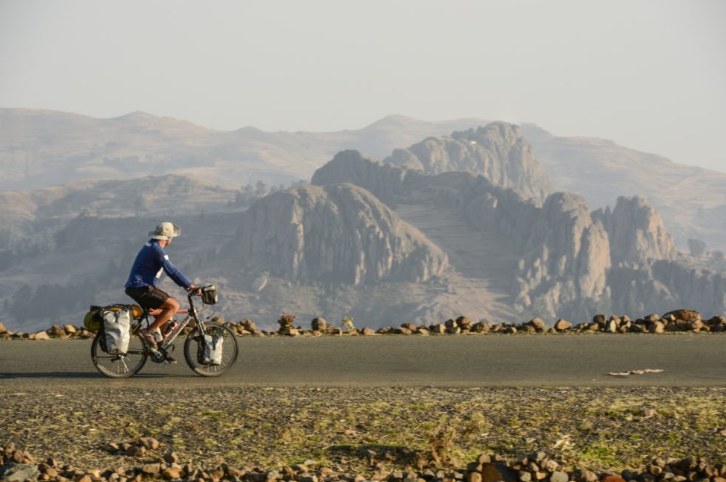
One bike, from the bottom of Africa to the top.
Lake Assal, in Djibouti, sits 155 m below sea level. It is the lowest point in Africa, and the third-lowest on land after the Dead Sea and the Sea of Galilee. Uhuru Peak, on Kilimanjaro, is the highest, at 5,895 m. Between them are the deserts of Djibouti and eastern Ethiopia, the Ethiopian highlands, the deserts of northern Kenya and the Equator.
People have cycled from Assal to the foot of Kilimanjaro and then walked up. People have taken bikes to the summit from the park gate. Nobody has joined the two: one bicycle, from the salt at Assal to the summit, without a break. That is what this is.
On the first morning we’ll fill a small vial with water from Lake Assal and carry it to the summit, so that the salt of the lowest point in Africa reaches the ice of the highest.
I rode past Lake Assal in 2014, on the way from Cape Town to Brighton through almost every country in Africa. I’ve wanted to come back and ride from it to the top of Kilimanjaro ever since.
It is also the recce for a trip I plan to run again. You get the first, and the rough edges that come with it.
Ride the whole way, or join us for the mountain.
Assal to Uhuru
Twenty-four riding days from Lake Assal to the foot of Kilimanjaro, a day off in Moshi, then seven days taking the bikes to the summit and back down. Arrive in Djibouti by Monday 15 February.
Up to 4 riders, plus meKilimanjaro by bike
Fly in to Kilimanjaro, meet the riders coming off the road, and take a bike up the Kilema route with us. Seven days on the mountain.
14 on the mountain in allFirst time through
Nobody has run this route before. It will be an old-school adventure, fully self-supported on the road, with most plans worked out on the fly. Future groups will ride the route we work out.
GPS tracked, possible Guinness World Record applicationStart and end dates for the whole way and the Kilimanjaro team may shift by a day or two. I’ll keep everyone who registers up to date as the plans are confirmed.
Down the Rift Valley to the mountain.
2,599 km by road and 24,740 m of climbing in 24 riding days, averaging about 108 km a day, with three rest days on the way and a day off in Moshi before the mountain. Mostly sealed roads. The highest point on the road is about 3,000 m, in the Ethiopian highlands.
Twenty-four days in the saddle.
| Djibouti to Addis Ababa | 790 km | |
|---|---|---|
| Wed 17 Feb | Lake Assal, 155 m below sea level. Start at the water, ride round the Ghoubet and south to Ali Sabieh | 125 km |
| Thu 18 Feb | Ali Sabieh to the border at Dewele, into Ethiopia, on to Aysha | 105 km |
| Fri 19 Feb | Aysha past Shinile to Dire Dawa | 120 km |
| Sat 20 Feb | Rest day, Dire Dawa | |
| Sun 21 Feb | Dire Dawa west along the foot of the Chercher highlands to Mieso | 140 km |
| Mon 22 Feb | Mieso to Awash | 110 km |
| Tue 23 Feb | Awash past Metehara and Welenchiti to Adama | 100 km |
| Wed 24 Feb | Adama up into the highlands to Addis Ababa, about 2,350 m | 90 km |
| Thu 25 Feb | Rest day, Addis Ababa | |
| Southern Ethiopia | 735 km | |
| Fri 26 Feb | Addis Ababa down into the Rift Valley to Ziway | 145 km |
| Sat 27 Feb | Ziway past the Rift Valley lakes to Hawassa | 115 km |
| Sun 28 Feb | Hawassa to Dilla, coffee country | 85 km |
| Mon 1 Mar | Dilla to Bule Hora | 105 km |
| Tue 2 Mar | Bule Hora to Yabelo | 95 km |
| Wed 3 Mar | Yabelo to Mega, Borena country | 95 km |
| Thu 4 Mar | Mega to Moyale. Cross into Kenya | 95 km |
| Northern Kenya | 559 km | |
| Fri 5 Mar | Moyale south on the A2 into the Dida Galgalu desert, to Turbi | 119 km |
| Sat 6 Mar | Turbi to Marsabit | 115 km |
| Sun 7 Mar | Rest day, Marsabit | |
| Mon 8 Mar | Marsabit to Laisamis | 95 km |
| Tue 9 Mar | Laisamis to Archer’s Post, Samburu country | 115 km |
| Wed 10 Mar | Archer’s Post through Isiolo, up the flank of Mount Kenya, across the Equator to Nanyuki | 115 km |
| Nairobi to Kilimanjaro | 515 km | |
| Thu 11 Mar | Nanyuki to Thika | 135 km |
| Fri 12 Mar | Thika round the east side of Nairobi to Kajiado | 115 km |
| Sat 13 Mar | Kajiado to Namanga. Cross into Tanzania | 80 km |
| Sun 14 Mar | Namanga to Arusha | 105 km |
| Mon 15 Mar | Arusha to Moshi, under the mountain | 80 km |
| Tue 16 Mar | Day off in Moshi. The Kilimanjaro team joins. Bike checks and park briefing | |
Provisional. Total distance and climbing are from the Komoot route. Overnight stops and daily distances are approximate. Most nights will be found on the way.
I've ridden this country before.
From the Cape Town to Brighton ride in 2014.
When people ask me which country I enjoyed riding through most, in Africa or anywhere, Ethiopia is usually one of my answers. It bears no resemblance to the Live Aid images of the 1980s. The food is some of the best in Africa, the beer is cheap, and apart from five years of Italian occupation it is one of only two African countries never colonised. Some of the mountain riding is spectacular.
Seven days on Kilimanjaro, with the bikes.
The Kilema route is the only route on Kilimanjaro where bikes are allowed. It is a 4x4 track up the south-east side of the mountain that joins the Marangu route at Horombo. Most of the lower mountain is rideable. The summit cone isn’t, for anyone, so on summit night the bikes go on our backs.
The road is self-supported. The mountain isn’t: park rules require licensed guides, and porters carry food and camping kit. Everyone carries their own bike, the whole way. No porter carries a bike at any stage.
The whole-way riders arrive with a month of riding in their legs and several days in the Ethiopian highlands at up to 3,000 m behind them. The Kilimanjaro team doesn’t, so there are two acclimatisation days at Horombo before we go higher.
- Wed 17 MarRide from Moshi up to the Kilema Gate, about 1,950 m, then into the forest to Kilema Camp. The Kilimanjaro team can start from the gate.
- Thu 18 MarKilema Camp to Horombo Huts, 3,705 m. Out of the forest and onto the moorland.
- Fri 19 MarAcclimatisation day at Horombo. Up towards Mawenzi, back down to sleep.
- Sat 20 MarSecond acclimatisation day at Horombo. Up towards the Saddle, back down to sleep.
- Sun 21 MarAcross the Saddle to Kibo Hut, 4,703 m. Early night.
- Mon 22 MarSummit. Leave around midnight with bikes on our backs, up the scree to Gilman’s Point (5,685 m), then round the crater rim to Uhuru Peak (5,895 m) at sunrise, with the vial of Assal water. Back down to Horombo.
- Tue 23 MarRide down from Horombo to the Kilema Gate. Night in Moshi.
- Wed 24 MarFly home from Kilimanjaro International (JRO).
Comfort hasn't made us happier.
Most of us live with more comfort than any generation before. In The Comfort Crisis, the American journalist Michael Easter argues that it hasn't made us happier. We adjust to each new comfort until it becomes the baseline, and along the way we lose the habit of doing anything difficult.
This is a large dose. Five weeks on the road with everything you need on your bike, heat in the Djibouti lowlands, wind in northern Kenya, most nights in a tent by the road, then a night at 4,700 m and a bike on your back up the scree. Nobody is guaranteed the summit.
That is what Unlikely Expeditions is for: hard days, adventure, and coming home having done something well outside your comfort zone.
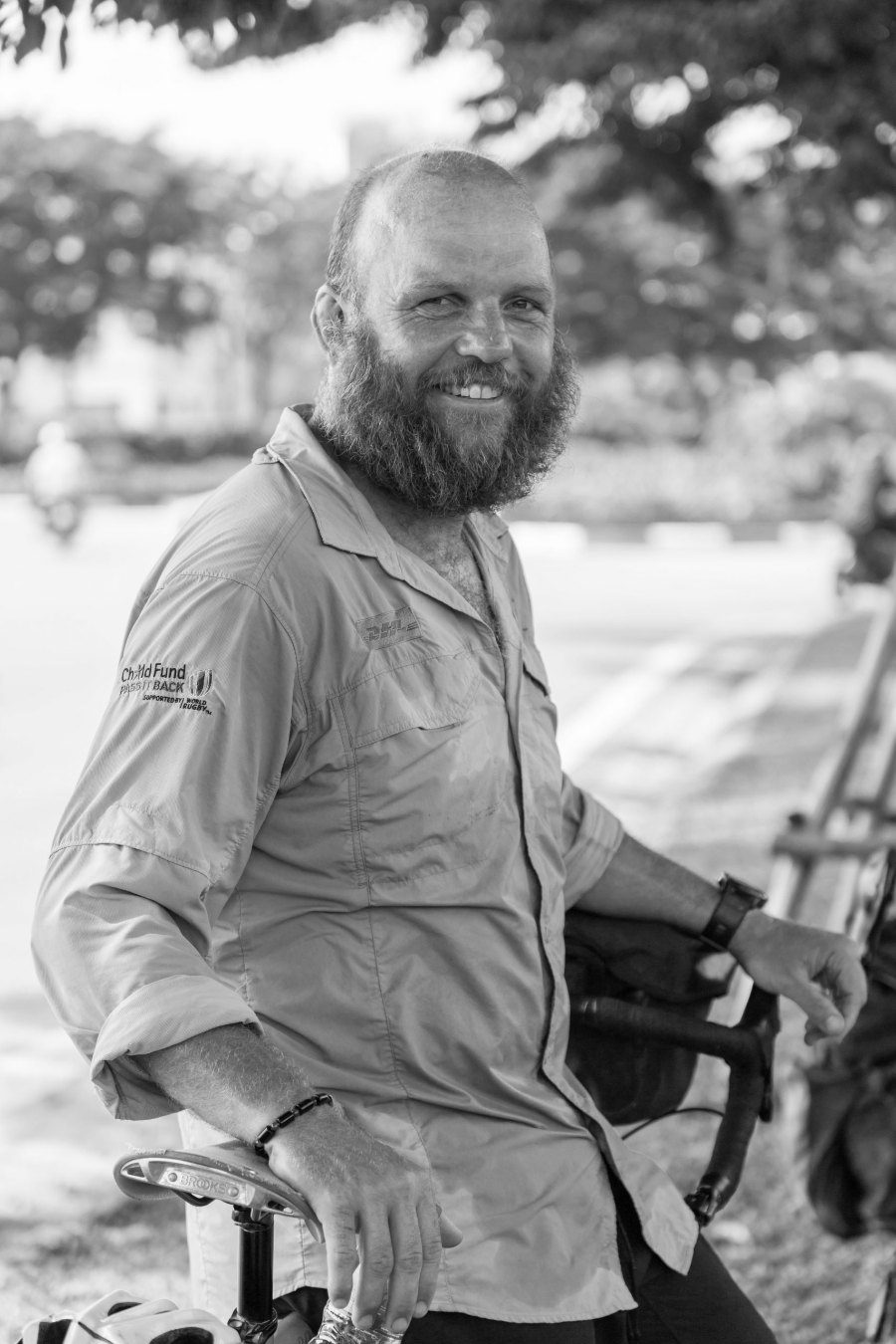
Ron Rutland
I've cycled about 95,000 km through 120 countries on six continents, on three long rides: Cape Town to Brighton through almost every country in Africa, London to Tokyo, and Tokyo to Paris via South America. The London to Tokyo ride became the film Everything In Between.
None of it needed special talent. It needed a decision to start, and the stubbornness to keep going when stopping made more sense. More about me in the FAQ.
I'll lead this one from the water at Assal to the summit, and I'll carry my own bike up the mountain like everyone else.
Unlikely Expeditions runs hard trips for people who don't think of themselves as adventurers. The unlikely one is always you.
Interested in the whole way or the mountain? Send me a note. It commits you to nothing.
Register your interestWhat people ask.
Who is Ron Rutland?
I’m a South African adventurer and speaker, based in Nottingham Road in the KZN Midlands. I started out in finance, spending many years in the UK and Asia, then started and ran an events business in Cape Town that hosts the Cape Town Tens every year. Most recently I spent just over two years as Director of the Old Boys’ Club at Michaelhouse, before deciding I needed to spend more time outdoors, sharing the best places I’ve found with other people.
From 2013 to 2015 I spent 27 months cycling some 42,000 km from Cape Town to Brighton, through (almost) every country in Africa, for the 2015 Rugby World Cup. In 2017 came The Longest Hole in Mongolia, which became a film of the same name. In 2019, with a replaced hip, I cycled 20,093 km from London to Tokyo with James Owens, delivered the match whistle for the opening game of the Rugby World Cup, and raised a significant amount for ChildFund Rugby. That ride became the film Everything In Between.
In 2022 Adam Nunn and I went back to Tokyo and spent 20 months cycling to Paris, via South America, delivering the whistle for the Women’s Rugby World Cup in New Zealand in 2022 and the men’s tournament in France in 2023, again for ChildFund Rugby. Those three long rides took me through 120 countries on six continents, about 95,000 km in all.
Before the Africa ride I was a fat former prop with no adventure experience at all, probably the least likely person to attempt it. Twenty-seven months later I knew I was capable of far more than I had assumed, and that most of what I gained came from the hard parts.
Is it really a world first?
Yes. The road from Lake Assal to Kilimanjaro has been cycled before. In 2011 Kyle Henning rode from Assal to Tanzania and then climbed Kilimanjaro on foot, and others have done versions of the same since. Separately, a few dozen people have taken bikes to the summit of Kilimanjaro, but every one of them started at a park gate.
Nobody has done both: one bicycle, from the lowest point in Africa to the highest, without a break. That is the first. Everyone who rides the whole way shares it.
It will be recorded properly: continuous GPS from the water at Assal, witnesses at the start, and the national park’s bicycle permit and summit record. A Guinness World Records application is possible.
Does the Kilimanjaro team count towards the world first?
No. The first belongs to the riders who start at Assal. The Kilimanjaro team climbs the same mountain on the same days, with bikes, and stands on the same summit. You just get there by plane.
How fit do I need to be?
Whole way: 24 riding days in five weeks, 2,599 km and 24,740 m of climbing, averaging about 108 km a day, with the longest day around 145 km. Some of it is in desert heat and some is near 3,000 m. There is no support vehicle, so you carry everything you need. You should have done back-to-back long days on a loaded bike before, and enjoyed them.
Kilimanjaro team: fit enough to walk uphill for six or seven hours at altitude while pushing or carrying a mountain bike. Hill walking with a loaded pack is better preparation than riding. If you’re not sure, ask me.
What bike do I need?
A mountain bike, hardtail or full suspension, in good condition, set up to carry your own kit with bags or racks. Everything not needed on the mountain is left in Moshi, and on summit night you carry the bike. Everyone carries their own bike, the whole way. No porter carries a bike at any stage.
Whole-way riders use one bike from Assal to the summit. I’ll send kit and bike recommendations to everyone who registers.
What will the weather be like?
Djibouti and the lowlands of eastern Ethiopia are in their coolest season in February, which still means 30°C and more by midday, so we start early. The Ethiopian highlands are dry and cool, northern Kenya is hot and dry, and the Kenyan and Tanzanian highlands are warm.
On Kilimanjaro, late March is the end of the dry window. The long rains usually arrive in the second half of March or in April, so expect some wet days in the forest, cloud, and possibly fresh snow on the summit. Pack for all of it. A full kit list comes with the itinerary.
What about the altitude?
The whole-way riders arrive having ridden up to 3,000 m in Ethiopia, which helps, though that was two weeks earlier. The Kilimanjaro team flies in, so the plan has two acclimatisation days at Horombo before the push to Kibo. Guides check everyone’s oxygen levels every day, and a guide’s decision to turn someone round is final.
Where do we sleep?
On the road, mostly wild camping, with some cheap and cheerful guesthouses thrown in. There is no support vehicle. This is fully self-supported: you carry your own tent, kit, food, water and spares on the bike. On the mountain, a camp at Kilema and the park huts at Horombo and Kibo.
How much will it cost?
I’ll send costs and the full itinerary to everyone who registers interest, in the order they registered. Registering costs nothing and commits you to nothing.
How do I get there and home?
Whole way: fly into Djibouti with your bike, arriving by Monday 15 February. Tuesday 16 February is for building bikes and a briefing.
Kilimanjaro team: fly into Kilimanjaro International (JRO), arriving by Tuesday 16 March for the briefing in Moshi that evening.
Everyone flies home from Kilimanjaro International on Wednesday 24 March.
What about visas?
Whole way: Djibouti, Ethiopia, Kenya and Tanzania. South Africans can enter Kenya and Tanzania without a visa. Djibouti and Ethiopia need visas for everyone, and other passports may need visas for all four. Ethiopia takes the most time: we cross by land, so the online e-visa doesn’t work and you’ll need a visa from an Ethiopian embassy before you leave. Kilimanjaro team: Tanzania only. Full details go to everyone who registers.
Do I need insurance?
Yes. Medical cover including emergency evacuation, valid for cycling and for altitude up to 6,000 m. Requirements come with the booking terms.
Have a question that isn't here? WhatsApp or call me on +27 72 636 3300 and I'll add the answer.